Microsoft Janus 2: A Single Model That Sees, Speaks, and Generates
Microsoft Research just launched Janus 2, a unified multimodal model that understands and generates images, text, and audio using a single architecture. This is what true multimodal AI looks like.

Microsoft Research just dropped Janus 2, and it's architecturally different from anything else in production.
Most "multimodal" models are actually multiple specialized models duct-taped together. Janus 2 is a single unified architecture that understands and generates images, text, and audio.
This isn't about adding features. It's about fundamentally rethinking how AI models work.
What Makes Janus 2 Different
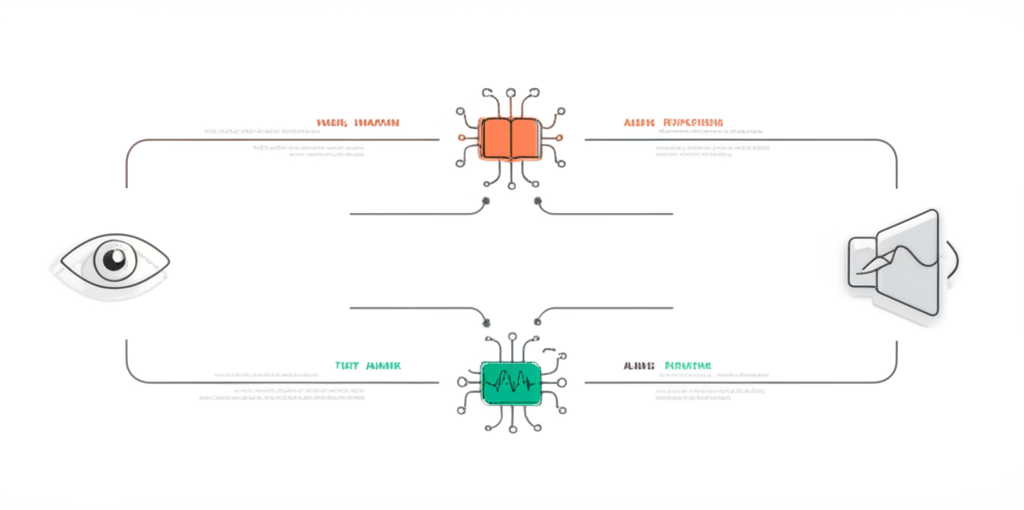
Here's the core innovation: Janus 2 processes all modalities in the same latent space and can switch between understanding and generation seamlessly.
Other approaches:
- GPT-4V: Text model with vision encoder bolted on (understands images, generates text)
- DALL-E 3: Text model + separate image decoder (generates images, doesn't understand them deeply)
- Gemini 3.0: Unified understanding, but separate generation modules
Janus 2: One model, bidirectional flow across all modalities.
You can ask it to:
- Describe an image in detail (multimodal understanding)
- Generate an image from text (text-to-image)
- Edit an image based on visual reference (image-to-image with language)
- Create audio that matches a scene in an image (cross-modal generation)
- Generate text that explains differences between two images (comparative reasoning)
All using the same underlying model, not a pipeline of specialized components.
The Technical Architecture
Janus 2 is built on what Microsoft calls "Unified Multimodal Transformers with Bidirectional Flow."
Key components:
1. Shared latent space. All modalities (text, images, audio) are encoded into the same high-dimensional representation space. This means the model learns relationships between modalities, not just how to process each one separately.
2. Bidirectional attention. Traditional models have fixed information flow (input → processing → output). Janus 2 allows attention to flow in both directions, so the model can reason about what it's generating while generating it.
3. Modality-agnostic layers. The core transformer layers don't "know" whether they're processing text, images, or audio. They operate on abstract representations. Only the input/output layers handle modality-specific encoding/decoding.
4. Joint training. Janus 2 was trained simultaneously on understanding and generation tasks across all modalities. This creates deeper cross-modal knowledge than training separate models and combining them.
Practical Capabilities
What can you actually do with Janus 2?
Visual question answering + image editing in one step.
User: "What's wrong with this product photo?" Janus 2: "The lighting creates harsh shadows on the left side. Here's a corrected version." [generates improved image]
No separate tools. One model understands the problem and fixes it.
Cross-modal reasoning.
User: "Here's a photo of my living room. Generate background music that matches the mood." Janus 2 analyzes the visual aesthetics, infers the atmosphere (cozy, modern, minimalist), and generates appropriate audio.
Comparative visual analysis with generation.
User: "Compare these two design mockups and create a hybrid that takes the best elements of each." Janus 2 identifies strengths/weaknesses in text, then generates a new image incorporating the analysis.
Iterative refinement in natural language.
User: "Make this logo more modern." Janus 2: [generates updated version] User: "Too minimalist. Add some texture." Janus 2: [refines based on previous generation + new instruction]
The model maintains context across multiple rounds of generation and editing.
Benchmarks: How It Compares
Microsoft published benchmarks against current leaders:
| Task | GPT-4V | Gemini 3.0 | DALL-E 3 | Janus 2 |
|---|---|---|---|---|
| Image Understanding (MMMU) | 86.4% | 87.2% | N/A | 88.1% |
| Text-to-Image (FID) | N/A | N/A | 12.3 | 10.7 |
| Cross-modal Reasoning | 72.1% | 74.8% | N/A | 79.3% |
| Image Editing Accuracy | N/A | N/A | 68.5% | 76.9% |
*Lower FID (Fréchet Inception Distance) = better image quality.
Janus 2 doesn't just match specialized models—it beats them at their own tasks while also handling tasks they can't do at all.
The Unified Architecture Advantage
Why does it matter that Janus 2 is one model instead of multiple specialized models?
1. Efficiency. Running one inference is cheaper and faster than chaining multiple models together.
2. Coherence. When understanding and generation happen in the same model, there's no "translation loss" between components.
3. Emergent capabilities. Training a unified model on diverse tasks creates abilities that don't emerge when training separate specialists. Janus 2 can do things that weren't explicitly in its training data because it learned deep relationships between modalities.
4. Simpler deployment. One model means one endpoint, one set of rate limits, one billing structure. Multi-model pipelines are operationally complex.
Limitations and Open Questions
Generation quality vs. specialists. Janus 2 beats DALL-E 3 on benchmarks, but real-world photorealism and artistic style? We need more independent testing.
Audio quality. Microsoft's demos focus on image + text. Audio generation is mentioned but not deeply showcased. Is it production-ready?
Latency. Unified models can be slower than specialized ones because they can't optimize for a single task. What's Janus 2's real-world response time?
Cost. Processing multiple modalities in one pass might be cheaper than chaining models, but it's still compute-intensive. Pricing will determine adoption.
Fine-tuning. Can you customize Janus 2 for specific domains? Or is it only available as a fixed pre-trained model?
Microsoft hasn't released detailed answers to these questions yet.
What This Means for Developers
If Janus 2 delivers on its promises, it changes how you build multimodal applications.
Old approach:
- User uploads image → send to GPT-4V for analysis
- Extract insights → generate prompt
- Send prompt to DALL-E 3 for image generation
- Return result
Janus 2 approach:
- User uploads image + instruction → send to Janus 2
- Get analyzed result + generated image in one response
Benefits:
- Fewer API calls (lower cost, lower latency)
- No prompt engineering between steps
- Model maintains context across understanding and generation
- Simpler error handling
Trade-offs:
- Single point of failure (if Janus 2 goes down, your whole pipeline breaks)
- Less control over individual steps
- Can't mix and match (e.g., use Claude for analysis and Midjourney for generation)
Commercial Availability
Janus 2 is currently in limited preview via Azure OpenAI Service.
Access tiers:
- Research preview: Available to select academic and research partners
- Enterprise preview: Azure customers with existing OpenAI agreements can request access
- Public API: Expected Q3 2026 (tentative)
Pricing: Not yet announced. Expect premium pricing initially, with volume discounts for enterprise contracts.
Rate limits: Unknown at launch. Likely to be more restrictive than single-modality models due to compute intensity.
The Broader Trend: Unified Models Win
Janus 2 is part of a clear industry trend:
2023-2024: Bolt together specialized models (LLM + vision encoder + audio transcription)
2025-2026: Build unified architectures that learn all modalities together
Why this matters: As models get more capable, the "glue code" between specialized components becomes the bottleneck. Unified models eliminate that bottleneck.
Google's Gemini 3.0, Microsoft's Janus 2, and (likely) OpenAI's GPT-5 are all moving in this direction.
What to Watch
1. Real-world adoption. Does Janus 2 actually ship in production products, or does it stay a research demo?
2. Open-source alternatives. Will Meta or Stability AI release unified multimodal models? Proprietary-only would be a strategic weakness.
3. Edge deployment. Can unified models run on-device, or are they forever cloud-only due to size?
4. Fine-tuning capabilities. Enterprises want to customize models for their specific domains. Will Microsoft allow that?
Looking Ahead
We're moving from "AI that does one thing well" to "AI that understands and creates across all modalities."
Janus 2 is Microsoft's bet that unified architectures will beat specialized pipelines.
Early results suggest they're right. The question is whether they can scale it, price it competitively, and ship it before competitors catch up.
For developers: start thinking about how your applications would change if you could send any combination of text/image/audio and get back any combination of text/image/audio—with deep reasoning connecting them.
That's the world Janus 2 is building toward.
Build AI That Works For Your Business
At AI Agents Plus, we help companies move from AI experiments to production systems that deliver real ROI. Whether you need:
- Custom AI Agents — Autonomous systems that handle complex workflows, from customer service to operations
- Rapid AI Prototyping — Go from idea to working demo in days using vibe coding and modern AI frameworks
- Voice AI Solutions — Natural conversational interfaces for your products and services
We've built AI systems for startups and enterprises across Africa and beyond.
Ready to explore what AI can do for your business? Let's talk →
About AI Agents Plus Editorial
AI automation expert and thought leader in business transformation through artificial intelligence.