Perplexity 'Computer': The AI Agent Platform That Actually Ships
Perplexity just launched 'Computer,' a platform of specialized AI agents that reason, search, build, and delegate. It's positioned between workflow automation and full autonomy—and it might be the first AI agent product that businesses will actually use.
While most AI companies are still demoing agent prototypes, Perplexity just shipped a production platform called "Computer" that bundles multiple specialized AI agents into what they're calling a "general-purpose digital worker." It reasons, delegates, searches, builds, remembers, codes, and delivers—all inside one system.
This isn't vaporware. It's live. And if you're running operations at a startup or SMB, this is the kind of AI tooling you should be paying attention to.
What Computer Actually Does
Perplexity Computer is built around sub-agents—specialized AI systems that handle different types of tasks:
- Reasoning agents break down complex problems into steps
- Search agents pull real-time information from the web and internal sources
- Code agents write and execute scripts to automate workflows
- Memory agents track context across sessions and remember user preferences
- Delegation agents route tasks to the right specialist
The platform sits somewhere between tools like Zapier (workflow automation) and the still-theoretical "AGI personal assistant." Perplexity is calling it a general-purpose digital worker, which feels more honest than calling it an AGI prototype.
For context, this positions Computer as a competitor to systems like OpenClaw and Anthropic's Claude Cowork—agent frameworks designed to handle multi-step business workflows without constant human supervision.
Why This Matters More Than Another AI Demo
Most AI agent announcements are science projects. Computer is shipping with actual use cases:
Customer support automation: Computer can ingest support tickets, search your knowledge base, draft responses, escalate edge cases, and log everything—without you building custom integrations.
Research and reporting: Give it a topic, and Computer will search multiple sources, synthesize findings, generate a report, and cite sources. It's what analysts do, but faster and without the overhead.
Codebase navigation and documentation: Point Computer at a GitHub repo, and it can explain how modules work, suggest improvements, or write documentation. It's like having a senior engineer available 24/7 for onboarding.
Data pipeline management: Computer can monitor data flows, flag anomalies, trigger alerts, and even write fixes for common issues.
The key difference from earlier "AI assistant" products is that Computer doesn't just answer questions—it takes actions. It writes code. It modifies workflows. It remembers what worked last time and adapts.
That's the shift from assistant to agent.
How It Compares to What's Already Out There
If you've been following AI agents, you know the landscape is crowded:
- ChatGPT with plugins can call APIs and search the web, but it's reactive. You drive every step.
- Claude with tool use is similar—powerful for single tasks, but not designed for multi-step workflows that run unsupervised.
- Auto-GPT and BabyAGI were early autonomous agent experiments, but they were research demos, not production tools.
- LangChain and LlamaIndex let you build custom agents, but you're writing code and managing infrastructure.
Perplexity Computer is pre-built, multi-agent, and production-ready. You don't need a team of ML engineers to deploy it. That's the whole pitch.
The closest comparison is probably Anthropic's Claude Cowork, which also positions itself as a business-focused agent platform. The difference is Cowork leans more into collaborative human-AI workflows, while Computer is designed to run more autonomously.
The Technical Angle: How It Actually Works
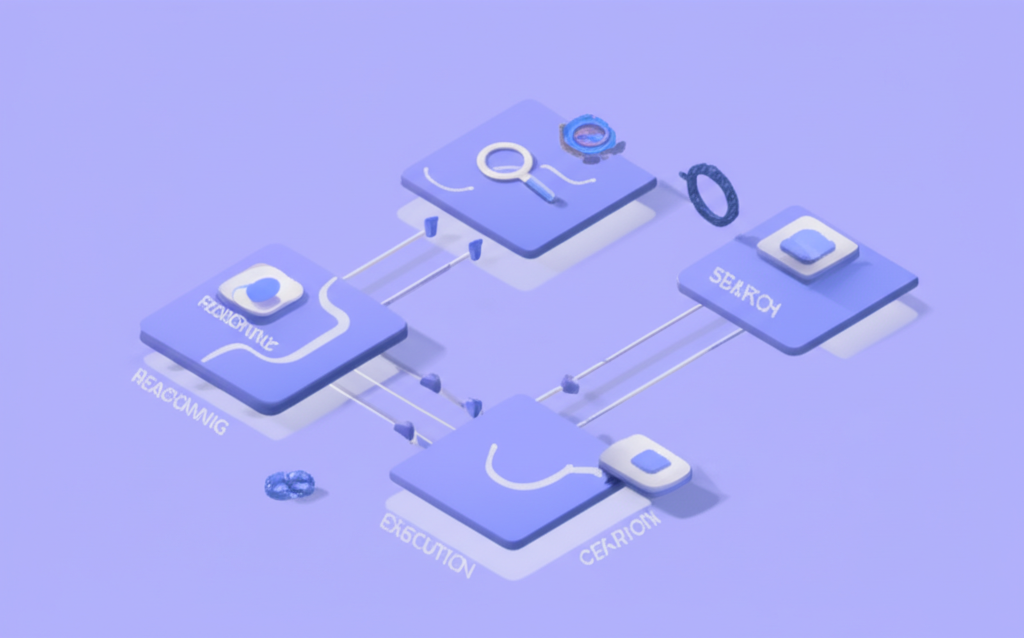
Under the hood, Computer uses a multi-agent orchestration layer that decides which specialist agent to invoke based on the task. Think of it like a project manager routing tickets to the right engineers.
When you give Computer a complex task—say, "analyze competitor pricing and generate a report"—here's what happens:
- Reasoning agent breaks the task into steps: identify competitors, scrape pricing pages, structure data, generate insights, format report
- Search agent finds competitor websites and extracts pricing data
- Code agent writes a script to structure the data into a table
- Reasoning agent synthesizes insights from the data
- Code agent generates a formatted report (PDF, markdown, whatever you need)
- Memory agent logs what you asked for so next time it knows your format preferences
All of this happens in one session. You don't manually orchestrate each step.
That's the breakthrough. Earlier AI tools could do each step individually if you prompted them carefully. Computer automates the orchestration.
What This Means For Your Business
If you're evaluating AI tools, here's what Perplexity Computer changes:
-
If you're in ops: Computer can automate the repetitive analysis and reporting tasks that eat up hours every week. It won't replace your ops team, but it'll make a small team feel like a much bigger one.
-
If you're managing support: AI agent platforms like Computer can handle tier-1 support tickets end-to-end. That means your human agents focus on edge cases and relationship-building, not password resets.
-
If you're building products: Computer-like agent systems are going to be table stakes for SaaS products within 18 months. Your users will expect tools that "just handle it" instead of tools that require manual configuration.
-
If you're evaluating AI vendors: Don't just ask "can this AI answer questions?" Ask "can it complete a workflow unsupervised?" That's the new bar.
The Risks Nobody's Talking About
Autonomous agents sound great until they make a mistake at 3 AM and you wake up to a mess. Here's what to watch for:
Hallucination at scale: When an AI assistant hallucinates, you catch it immediately. When an autonomous agent hallucinates and executes based on bad data, you might not notice until damage is done.
Scope creep: Agents designed to "handle workflows" will eventually try to handle workflows you didn't authorize. Make sure you have strict permission boundaries.
Vendor lock-in: If Computer becomes critical infrastructure and Perplexity changes pricing or shuts down features, you're stuck. Build escape hatches.
Compliance and audit trails: If an agent makes a decision that violates a regulation, who's responsible? Make sure your AI tools log everything and that you understand the legal exposure.
None of these are reasons not to use AI agents. They're reasons to deploy them carefully.
What to Watch Next
Perplexity Computer is one of the first production-ready multi-agent platforms from a major AI company. If it works and businesses adopt it, expect:
- OpenAI to ship a competing product within 6 months
- Anthropic to expand Claude Cowork's capabilities to match
- Microsoft to bundle agent orchestration into Copilot
- Google to integrate agent workflows into Gemini
The race isn't about who has the best single AI model anymore. It's about who builds the best agent platform—the one that businesses trust to run unsupervised.
If you're waiting for AI agents to be "ready," they're ready now. The question is whether you're ready to trust them.
Build AI Agents That Actually Work For You
At AI Agents Plus, we don't just talk about AI agents—we build them. Whether you need:
- Custom Multi-Agent Systems — Specialized agents that handle your specific workflows, not generic demos
- Rapid Agent Prototyping — Go from idea to working proof-of-concept in days using modern agent frameworks
- Voice-Enabled Agents — Conversational AI that can take actions, not just answer questions
We've built agent systems for startups and enterprises that need AI to deliver ROI, not just impress investors.
Ready to explore what AI agents can do for your business? Let's talk →
About AI Agents Plus Editorial
AI automation expert and thought leader in business transformation through artificial intelligence.