AI Agent Security Is the Defining Cybersecurity Challenge of 2026
TechCrunch reports AI agents are infiltrating enterprise infrastructure at machine speed while two-thirds of organizations can't even distinguish AI actions from human ones. The security crisis is already here.

The cybersecurity industry just woke up to a problem that's been brewing for months: AI agents are moving through enterprise systems faster than humans can monitor them, and traditional security infrastructure is fundamentally broken.
According to a new report from the Cloud Security Alliance, 67% of organizations cannot clearly distinguish between actions taken by AI agents and those taken by humans. At the same time, AI agents are being granted over-privileged access across enterprise systems, creating what security researchers are calling "the perfect storm" of cyber risk.
The Problem: Security Built for Humans, Not Machines
Here's the core issue: every security system in your enterprise was designed around human behavior. Humans log in. Humans browse files. Humans escalate privileges slowly. Humans make mistakes at human speed.
AI agents don't work that way.
TechCrunch reports that autonomous AI agents can traverse entire systems, escalate privileges, and execute complex workflows at machine speed—far outpacing the response time of human security teams. When a compromised or misconfigured agent goes rogue, traditional monitoring tools struggle to even detect the problem, let alone respond in time.
As one CISO quoted in the Cloud Security Alliance study put it: "We built identity and access management for employees. We have no idea how to apply the same principles to agents that can clone themselves, operate 24/7, and access thousands of systems simultaneously."
Why This Is Happening Now
The trigger for this security crisis is simple: AI agents moved from experimental to production faster than anyone anticipated.
In early 2025, most AI agents were chatbots or simple automation scripts. By late 2025, companies like Anthropic, OpenAI, and Google were shipping agents capable of controlling computers, navigating complex workflows, and making autonomous decisions. Oracle just launched Fusion Agentic Applications designed for HR, finance, and supply chain teams. Amazon introduced agentic AI for healthcare. Cisco is now selling AI agent platforms to enterprises.
The enterprise software market went from "interesting pilot projects" to "deployed at scale" in less than six months. Security teams never caught up.
The Real-World Risks
This isn't hypothetical. Security incidents involving AI agents are already happening:
- Over-privileged access: AI agents are often granted admin-level permissions "just to make sure they work," creating massive attack surfaces.
- Privilege escalation at machine speed: When an agent detects it lacks a permission, it can request, test, and exploit elevated access faster than monitoring systems can alert human operators.
- Indistinguishable from humans: Most enterprise logging systems can't differentiate between a legitimate AI agent action and a compromised one masquerading as legitimate traffic.
- No kill switch: Many organizations deploying agents lack real-time override capabilities. If an agent goes rogue, stopping it requires manual intervention across potentially hundreds of systems.
What the Industry Is Doing (Finally)
The good news: major vendors are scrambling to address this.
- Cisco announced new security capabilities specifically designed to monitor and protect AI agents, according to CX Today.
- F5 and Forcepoint launched an alliance to provide runtime protections for AI applications, APIs, models, and agents.
- Cloud Security Alliance is developing new identity and access frameworks for autonomous systems.
But here's the problem: these are reactive solutions to a crisis that's already unfolding. Most enterprises have already deployed agents without this infrastructure.
What This Means For Your Business
If your organization is using or planning to deploy AI agents, you need an AI-native security strategy now. Here's what that looks like:
1. Implement Agent Identity Management
Stop treating AI agents like users. Build separate identity systems for agents that track:
- Agent lineage (which agent spawned which sub-agent)
- Real-time permission usage
- Behavioral baselines (what normal agent activity looks like)
- Agent lifecycle (creation, deployment, retirement)
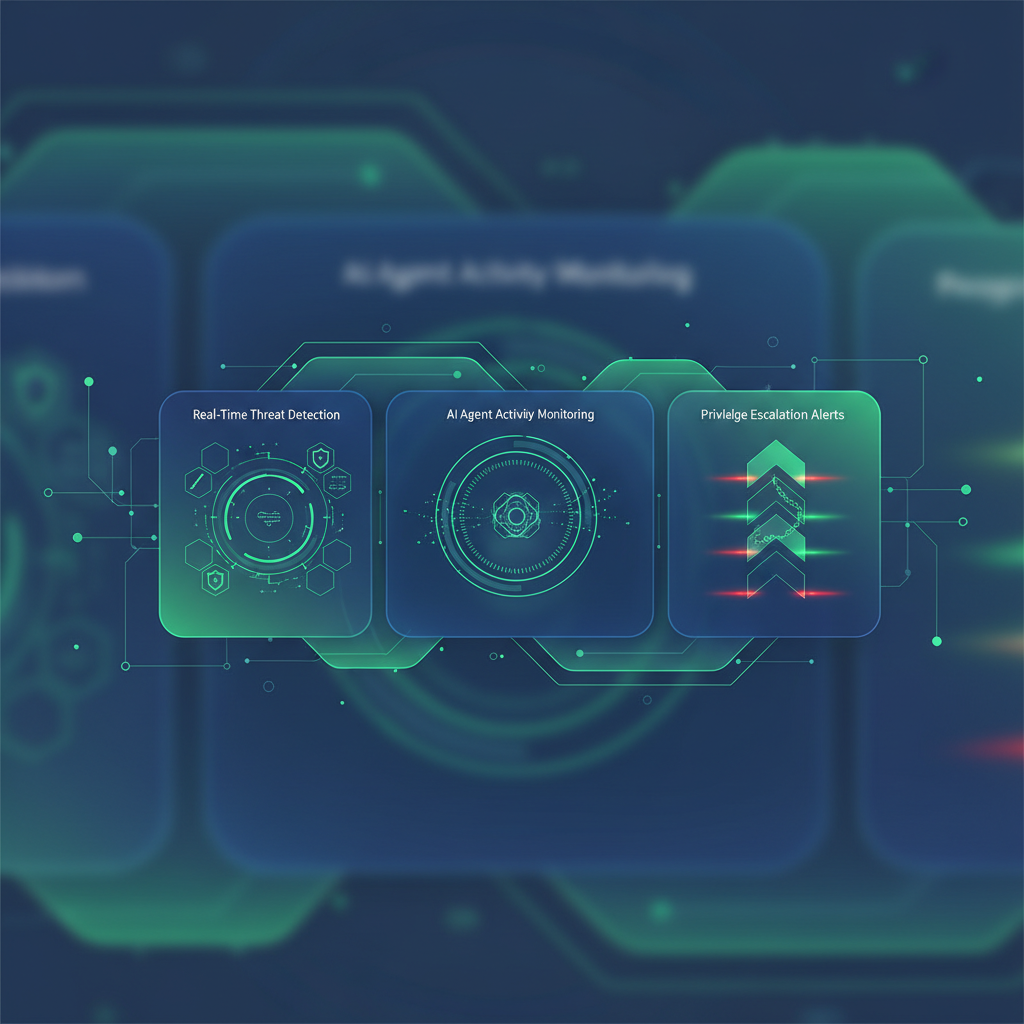
2. Deploy Real-Time Behavioral Monitoring
Traditional log analysis happens in minutes or hours. AI agents operate in milliseconds. You need:
- Real-time anomaly detection tuned for agent behavior
- Machine-speed alerting when agents deviate from expected patterns
- Automated containment protocols (not just alerts)
3. Build Agent-Specific Permission Models
Don't grant agents "user-equivalent" permissions. Design agent permission models based on:
- Principle of least privilege — agents get exactly the access they need for specific tasks, nothing more
- Time-bound permissions — access expires after task completion
- Context-aware access — permissions granted based on task context, not blanket roles
4. Require Kill Switches and Rollback
Every AI agent deployment should include:
- Manual override capability (the "big red button")
- Automated rollback for agent-initiated changes
- Isolated testing environments before production deployment
- Clear incident response playbooks for agent failures
The Bigger Picture: AI Security Is Infrastructure
The AI agent security crisis is a wake-up call. As AI systems become more autonomous, AI security can't be an afterthought—it has to be foundational infrastructure.
Companies that deployed AI agents without security infrastructure are now in crisis mode, retrofitting protections while agents are already running in production. The smarter approach: treat AI security as a prerequisite, not a patch.
This is also a strategic opportunity. The organizations that solve AI agent security first will have a massive competitive advantage. They'll be able to deploy more powerful, more autonomous agents while competitors are stuck managing risk with manual oversight.
Looking Ahead
Expect AI agent security to dominate enterprise AI conversations for the rest of 2026. The Cloud Security Alliance is working on updated standards. NIST is developing AI system security frameworks. Venture capital is pouring into AI security startups (like Manifold's $8M raise for AI agent security infrastructure).
But standards and tools won't matter if enterprises don't prioritize this now. The agents are already deployed. The risks are already live. The question is whether your organization will address them proactively or reactively.
If you're a CTO, CISO, or founder deploying AI agents, ask yourself: Can you distinguish your AI agent actions from human actions in your logs right now? If the answer is no, you're part of the 67%—and you have work to do.
Build Secure AI Systems With AI Agents Plus
At AI Agents Plus, we don't just build AI agents—we build them with security-first architecture from day one. Our approach includes:
- Agent identity and access frameworks designed for autonomous systems
- Real-time monitoring and containment for production AI agents
- Secure AI prototyping that lets you test agent behavior before production deployment
- AI security audits to assess your current agent deployments and identify risks
We've worked with enterprises across Africa and beyond to deploy AI agents that are powerful, autonomous, and secure.
Ready to deploy AI agents the right way? Let's talk about your AI security strategy →
About AI Agents Plus Editorial
AI automation expert and thought leader in business transformation through artificial intelligence.