Enterprise AI Implementation Challenges: What Every Leader Should Know in 2026
Enterprise AI implementation promises transformative value, but the path from proof-of-concept to production is challenging. Learn the top challenges and how to overcome them.
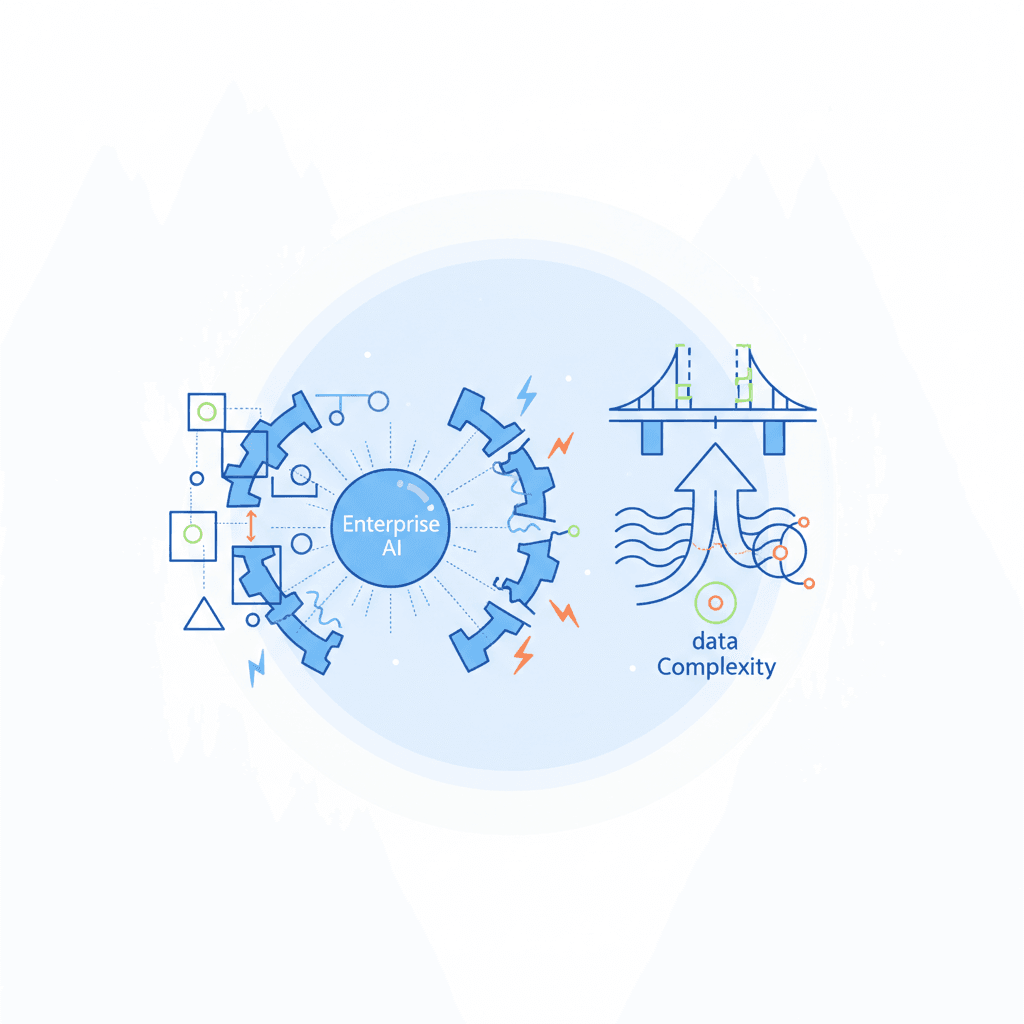
Enterprise AI implementation promises transformative business value, but the path from proof-of-concept to production is littered with challenges. In 2026, while AI technology has matured significantly, organizations still struggle with integration complexity, data governance, organizational readiness, and scaling pilot projects into enterprise-wide systems.
Understanding these enterprise AI implementation challenges — and how to navigate them — separates successful AI initiatives from expensive failures.
The Top Enterprise AI Implementation Challenges
1. Data Quality and Accessibility
The Challenge:
AI models are only as good as the data they're trained on. Enterprise data is typically:
- Siloed across departments and systems
- Inconsistent in format and quality
- Incomplete or outdated
- Trapped in legacy systems
- Subject to complex access restrictions
The Impact:
Poor data quality leads to inaccurate AI predictions, biased outcomes, and low user trust.
Solutions:
- Implement data governance frameworks before AI projects
- Invest in data quality tools and processes
- Create unified data lakes or warehouses
- Establish clear data ownership and stewardship
- Build data pipelines that maintain quality at scale
2. Integration with Legacy Systems
The Challenge:
Modern AI solutions must integrate with decades-old enterprise systems that weren't designed for AI:
- ERPs, CRMs, and databases with limited APIs
- On-premises infrastructure with strict security requirements
- Proprietary formats and protocols
- Systems with minimal documentation
Solutions:
- Build robust middleware/integration layers
- Use API-first architectures where possible
- Consider gradual migration strategies
- Plan for hybrid cloud/on-premises deployments
3. Organizational Change Management
The Challenge:
AI transforms how work gets done, threatening established processes and roles:
- Employee resistance to AI-driven changes
- Fear of job displacement
- Lack of AI literacy across the organization
- Unclear ownership and accountability
Solutions:
- Involve stakeholders early in AI project design
- Communicate clearly about AI's role (augmentation vs. replacement)
- Provide comprehensive training programs
- Celebrate early wins and champions
- Align incentives with AI adoption
4. Skills Gap and Talent Shortage
The Challenge:
Enterprise AI requires specialized skills in high demand:
- Machine learning engineers and data scientists
- MLOps and AI infrastructure specialists
- Domain experts who understand both business and AI
- AI ethics and governance professionals

Solutions:
- Build internal AI capabilities through training
- Partner with AI vendors and consultancies strategically
- Use AutoML and low-code AI platforms
- Create centers of excellence
5. Model Performance and Accuracy
The Challenge:
Lab performance rarely matches production:
- Models trained on historical data may not reflect current conditions
- Edge cases expose weaknesses
- Data drift degrades accuracy over time
Solutions:
- Establish realistic performance benchmarks
- Implement continuous monitoring and alerting
- Build feedback loops for model improvement
- Plan for regular retraining and updates
6. Scalability and Performance
The Challenge:
Pilot projects work with small datasets. Production AI must handle:
- Enterprise-scale data volumes
- Thousands of concurrent users
- Real-time latency requirements
- High availability and disaster recovery
Solutions:
- Design for scale from the start
- Use cloud-native AI platforms for elastic scaling
- Optimize models for inference efficiency
- Implement caching and load balancing
7. Governance, Compliance, and Ethics
The Challenge:
Enterprise AI must comply with regulations and ethical standards:
- GDPR, CCPA, and other privacy laws
- Industry-specific regulations
- Algorithmic bias and fairness concerns
- Explainability requirements
Solutions:
- Establish AI ethics boards and governance frameworks
- Conduct bias audits and fairness assessments
- Implement explainable AI techniques
- Document data lineage and model decisions
- Engage legal and compliance teams early
8. ROI Measurement and Business Case Validation
The Challenge:
Proving AI's business value is difficult:
- Long time-to-value obscures ROI
- Benefits are often qualitative
- Attribution is unclear
- Costs include hidden expenses
Solutions:
- Define clear success metrics before starting
- Track both financial and non-financial benefits
- Conduct controlled A/B tests where possible
- Calculate total cost of ownership realistically
Case Study: Overcoming Implementation Challenges
Company: Global manufacturing enterprise (50,000+ employees)
Goal: Implement predictive maintenance AI across factories
Challenges Encountered:
- Data silos across factories
- Legacy machinery integration
- Maintenance team resistance
- Skills gap
Solutions Implemented:
- Built unified data lake
- Deployed edge AI models
- Partnered data scientists with maintenance teams
- Upskilled existing engineers
Results:
- 25% reduction in unplanned downtime
- 15% decrease in maintenance costs
- 95% user adoption after initial skepticism
Key Lesson: Technical solutions alone don't work. Success required equal investment in people, process, and technology.
Best Practices for Enterprise AI Implementation
Start Small, Think Big
Begin with focused pilot projects that deliver quick wins, but architect for enterprise scale from day one.
Build Cross-Functional Teams
Combine domain experts, data scientists, engineers, and business stakeholders.
Invest in Data Infrastructure First
Clean, accessible, governed data is the foundation.
Prioritize Explainability and Trust
Especially for high-stakes decisions, AI must explain its reasoning.
Plan for Continuous Improvement
AI isn't "build once, deploy forever." Budget for monitoring, maintenance, and retraining.
Measure What Matters
Define business-relevant KPIs. Technical metrics matter less than business outcomes.
Embrace Hybrid Intelligence
Combine AI's pattern recognition with human judgment. Most successful enterprise AI augments rather than replaces humans.
The Path Forward
Enterprise AI implementation in 2026 is less about technical capability and more about organizational readiness. The companies succeeding with AI share common traits:
- Executive sponsorship: AI initiatives have C-level champions
- Cultural openness: Experimentation and learning are encouraged
- Data maturity: Data is treated as a strategic asset
- Realistic expectations: Leaders understand AI's capabilities and limitations
- Long-term commitment: AI is viewed as a multi-year journey
Navigating enterprise AI implementation challenges requires patience, planning, and persistence — but the competitive advantages are worth it.
At AI Agents Plus, we help enterprises navigate AI implementation challenges. Whether you need strategy guidance, custom AI agents, or hands-on implementation support, let's talk about your AI journey.
About AI Agents Plus Editorial
AI automation expert and thought leader in business transformation through artificial intelligence.